
Heavy Bag, Heavy Gains: Master Your Kickboxing Workout
Why Kickboxing Heavy Bag Workouts Transform Your Fitness
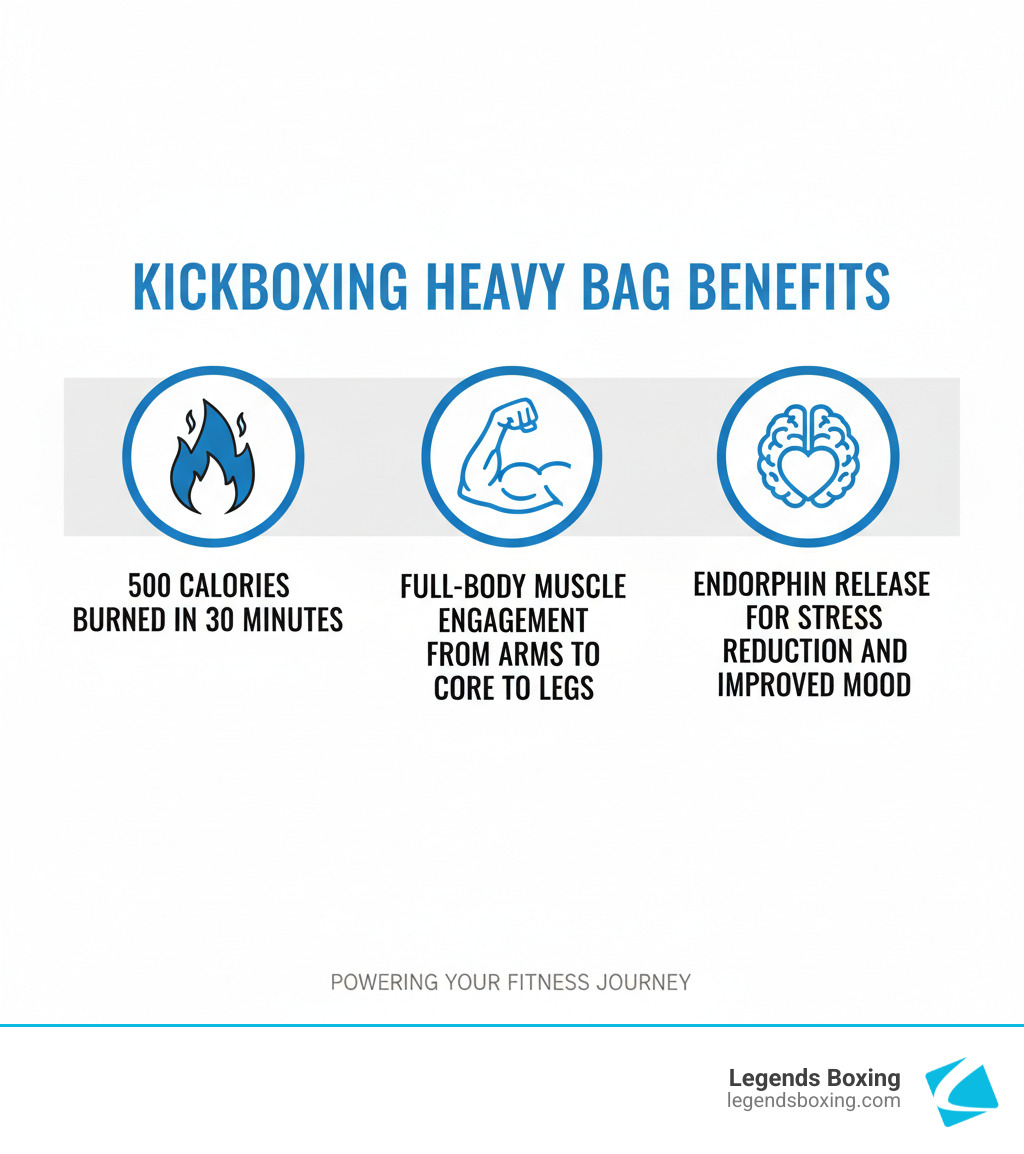
A kickboxing heavy bag workout is an intense, stress-busting session that builds strength, burns calories, and keeps you engaged. Here's what you can expect:
- High-Intensity Cardio: Burn up to 500 calories in just 30 minutes
- Full-Body Strength: Engage muscles from your arms to legs and core through resistance training
- Stress Relief: Release endorphins and channel frustration into powerful strikes
- Improved Coordination: Develop muscle memory and balance through repetitive movements
- Mental Toughness: Build discipline and focus while pushing through physical challenges
Instead of letting stress build up, channel it productively. As one fitness enthusiast put it: "Never realized boxing is such an awesome and enjoyable cardio! Super effective core workout as well."
The heavy bag is your practice opponent, stress outlet, and path to fitness gains. Unlike isolated gym exercises, it engages your entire body and mind simultaneously.
I'm Robby Welch, National Head Coach at Legends Boxing. I've designed our nationwide kickboxing programs and coached countless members. I've seen how the right approach to heavy bag training turns frustrated gym-goers into confident, energized athletes.
Must-know kickboxing heavy bag workout terms:
Why the Heavy Bag is Your Ultimate Kickboxing Partner
The heavy bag is your perfect training partner—always ready to work. A kickboxing heavy bag workout delivers benefits far beyond a treadmill or weight machine.
It's an incredible full-body workout. Proper punches and kicks engage your entire body. Power starts in your feet, travels through your legs and core, and explodes through your fists. Every muscle from your calves to your lats is involved.
Heavy bag training combines cardio and strength training into one efficient package. It's pure High-Intensity Interval Training (HIIT) in action. Intense striking rounds followed by brief rests torch calories—up to 500 in 30 minutes—while building lean muscle. This boosts your metabolism and cardiovascular endurance.
The bag develops serious punching power. The resistance builds muscle and teaches your body to generate force efficiently, making your strikes sharper and faster. Its predictability is perfect for developing accuracy and muscle memory by repeating combinations until they're second nature.
The bag also improves coordination and balance. Its swing forces you to stay light on your feet and aware of your positioning. Circling the bag and throwing combinations teaches your brain to coordinate multiple movements, a skill useful in everyday life.
But perhaps the best part? The stress relief. Channeling a rough day into powerful strikes triggers an endorphin release that improves your mood. As one of our members says, "It's cheaper than therapy, and way more fun." There's deep satisfaction in hitting the bag hard.
The heavy bag provides a productive, empowering outlet for life's frustrations.
Gearing Up and Getting Started: Your Pre-Workout Checklist
A few minutes of preparation makes all the difference between a powerful, injury-free kickboxing heavy bag workout and a frustrating one.
Essential Gear for Safety and Performance
Protecting your hands is crucial. The right gear isn't optional—it's essential.

The heavy bag provides resistance to develop power and accuracy. A 70-100 pound bag is ideal for most people as it absorbs strikes without excessive swinging.
Your boxing gloves are your first line of defense. We recommend 12-16 oz gloves for heavy bag work to cushion your knuckles and distribute impact. Lighter gloves offer less protection.
Don't skip hand wraps. Always wrap your hands before gloving up. They support your wrists and compress the small bones in your hand to prevent fractures. We teach proper wrapping technique in our first Legends Boxing class.
Wear proper athletic attire that allows free movement. Breathable, moisture-wicking fabrics and shoes with good lateral support are best for comfort and performance.
The Perfect Warm-Up Routine
Warming up is not a suggestion; it's essential for peak performance and injury prevention. A proper warm-up increases blood flow, improves joint mobility, and prepares you mentally.
A 5-10 minute dynamic warm-up is ideal. Start with 2 minutes of jumping jacks to get your heart pumping, followed by 2 minutes of jump rope (or mimicking it) to prime your footwork and coordination.
Perform arm circles (1 minute forward, 1 minute back) to mobilize your shoulders, which are key for punch power. Follow with 1 minute of high knees to engage your hip flexors and core.
Add torso twists to loosen your core for rotational power. Finish with 2 minutes of shadowboxing (light punches and kicks in the air) to connect your mind and body, rehearsing the movements for the bag.
Mastering Your Kickboxing Stance and Form
A solid stance is your foundation for power, balance, and safety in kickboxing.
For a basic kickboxing stance (orthodox/right-handed), place your left foot forward, feet shoulder-width apart, with toes pointing slightly out. Keep knees bent and weight even. Southpaws (left-handed) reverse this.
Your guard position is non-negotiable: hands up, always. Fists protect your chin and temples, elbows shield your ribs. This is your launchpad for strikes. Dropping your hands is a common mistake to avoid.
Keep your feet moving. Practice the boxer's shuffle—a light, bouncy slide forward, backward, and side-to-side while maintaining your stance. This keeps you agile.
Real power comes from pivoting. Your legs and hips generate force, not just your arms. When throwing a cross, pivot your back foot to drive your hips. For a roundhouse kick, pivot your planted foot for full hip rotation. A satisfying thud on the bag means you're doing it right.
The Ultimate Kickboxing Heavy Bag Workout
You've warmed up, you're in your stance, and now it's time for the main event. This is where your kickboxing heavy bag workout truly comes alive. Let's break down the foundational strikes and combinations.
Building Your Arsenal: Basic Punches, Kicks, and Knees
Mastering individual strikes is like learning the alphabet—it's fundamental for building combinations. Always prioritize technique over power to avoid developing bad habits.

- Jab (1): A quick, snappy lead hand punch used to set up other strikes. Extend your arm, rotate your fist palm-down on impact, and snap it back to your guard. Focus on speed, not power.
- Cross (2): Your power punch. Pivot your back foot and rotate your hips to drive your rear hand across your body. Hip rotation is key for power.
- Hook (3 or 4): A curved punch from the side. Pivot your foot and hip, swinging your arm in a horizontal arc with your elbow bent at 90 degrees.
- Uppercut (5 or 6): A vertical, close-range power shot. Drop your shoulder and drive your fist upward, rotating your hips into the punch.
- Roundhouse Kick: Step diagonally, pivot on your standing foot, and swing your rear leg in a wide arc, making contact with your shin. Power comes from hip rotation.
- Front Kick (Teep): Used to manage distance. Lift your knee and push your foot forward to create space.
- Knee Strike: A devastating close-range strike. Drive your knee straight up into the bag, engaging your core and hips.
At Legends Boxing, we break down each technique in detail. Learn what to expect in your first class and how we guide beginners through these fundamentals.
Killer Kickboxing Combinations for the Heavy Bag
After practicing individual strikes, chaining them into combinations transforms your workout into a flowing, dynamic session. Start simple and build from there:
- Jab-Cross (1-2): Your foundational combo.
- Jab-Cross-Hook (1-2-3): Add a hook for a seamless three-punch combo.
- Jab-Cross-Right Roundhouse Kick (1-2-Kick): A classic combo that flows from punches into a powerful kick.
- Jab-Right Knee-Left Hook: A great sequence for practicing at different ranges.
Once comfortable, experiment with your own combinations. Flow drills—moving around the bag and throwing strikes that feel natural—are great for developing creativity and finding your style.
Structuring Your Kickboxing Heavy Bag Workout Session
Proper structure is as important as technique. Our round-based approach at Legends Boxing is designed to maximize results and prevent burnout. Start with a 15-30 minute workout, including warm-up and cool-down. Structure your workout in 3-minute rounds with 1-minute rest periods. Aim for 50-70% of your maximum power to maintain good form.
Here's a sample 30-minute workout:
- 10-minute warm-up: Jumping jacks, jump rope, arm circles, high knees, torso twists, and shadowboxing.
- Round 1 (3 min): Jab-cross (1-2) combinations. Focus on footwork and form. Rest 1 min.
- Round 2 (3 min): Jab-cross-hook (1-2-3) combinations. Focus on hip rotation. Rest 1 min.
- Round 3 (3 min): Jab-cross-roundhouse kick combinations. Find your rhythm. Rest 1 min.
- Round 4 (3 min): Creative/Flow round. Mix up combinations. Rest 1 min.
- 5-minute cool-down: Gentle stretching and deep breathing.
This structure provides 12 minutes of intense bag work in a 30-minute session. Our classes at Legends Boxing follow this proven structure with the added benefit of coaching, community, and music to keep you motivated.
Level Up: Advanced Techniques and Common Mistakes
As your kickboxing heavy bag workout becomes more natural, you'll want to refine your technique. Knowing what not to do is just as valuable as learning advanced moves.
Common Mistakes to Avoid on the Heavy Bag
Even seasoned fighters make mistakes. The key is to be aware, adjust, and keep moving forward.
- Hitting too hard initially: This is a common mistake that leads to sloppy form and potential injury. Prioritize speed, snap, and precision; power will develop naturally.
- Neglecting footwork: This makes you a stationary target and limits your power. Constantly circle the bag, shuffle, and pivot with your strikes.
- Holding your breath: This kills endurance. Exhale sharply with each strike (a "tss" sound) to maintain power and prevent dizziness.
- Dropping your hands after striking: Always snap your hands back to your guard immediately to build good habits.
- Incorrect wrist form: This can cause injury. Keep your wrist straight and locked on impact, with knuckles aligned with your forearm.
- Pushing the bag instead of snapping punches: Real power comes from quick acceleration and retraction, like cracking a whip, not from leaning into your strikes.
Structuring a 4-Week Progressive Program
Consistency and smart progression are key. We recommend a 4-week program with three workouts per week to allow for adequate rest. This framework has proven successful for our members nationwide. Each week builds on the last, gradually increasing complexity and intensity.
| Week | Focus Area | Example Drills/Combinations | Goals |
|---|---|---|---|
| Week 1: Form & Basics | Perfecting fundamental strikes and stance | Jab-Cross (1-2), individual strike practice, footwork drills | Master proper technique for each basic strike; build confidence; establish consistent form; focus on 50% power |
| Week 2: Combinations | Linking strikes together smoothly | Jab-Cross-Hook (1-2-3), Jab-Cross-Kick, basic 3-4 strike combos | Develop fluidity between strikes; improve rhythm; maintain form through combinations; increase volume |
| Week 3: Power & Speed | Building explosive force and quickness | Speed rounds (max strikes in 30 seconds), power rounds (70-80% force), mixing tempo | Increase strike speed; develop explosive power; learn to vary intensity; push cardiovascular limits |
| Week 4: Endurance & Flow | Sustained output and creative combinations | Longer rounds (4 minutes), flow drills, custom combinations, reduced rest periods | Build mental toughness; maintain form under fatigue; create personal combo sequences; prepare for regular class intensity |
Progressive overload means constantly challenging yourself without overdoing it. Track your progress, like the number of clean combinations per round or how winded you feel. Small wins lead to big changes.
To see this approach in action, learn what to expect in your first class at Legends Boxing. Our coaches guide your progression at your pace, keeping you challenged and motivated. Every champion started where you are. They succeeded through consistency, learning from mistakes, and trusting the process.
Frequently Asked Questions
It's natural to have questions before you dive into your first kickboxing heavy bag workout. Let's tackle the most common ones.
How long should a beginner's heavy bag workout be?
For beginners, a kickboxing heavy bag workout should be 15 to 30 minutes total, including warm-up and cool-down. The focus should be on building solid technique, not duration. Structure your workout with 2-3 minute rounds and 1-minute rest periods. As your fitness and technique improve, you can gradually increase the workout time.
Can I do a kickboxing heavy bag workout without a bag?
Yes, you can get an effective workout without a bag. Shadowboxing—throwing punches and kicks at an imaginary opponent—is an invaluable tool for perfecting form, footwork, and combinations without joint impact. You can also add bodyweight exercises like squats, lunges, and push-ups to increase intensity and build strength. Many of our members use shadowboxing to improve their technique before even hitting a bag.
What are the most common mistakes in a kickboxing heavy bag workout?
The most common mistakes are easily fixable. Be aware of the following:
- Incorrect form: Punching with a bent wrist or throwing wild strikes can cause injury. Keep wrists straight and rotate your hips for power.
- Dropping your guard: Always bring your hands back to your face after a strike to build good habits.
- Neglecting footwork: Stay mobile by circling the bag and pivoting. Don't stand flat-footed.
- Holding your breath: Exhale sharply with every strike to maintain power and endurance.
- Pushing the bag: Snap your punches and kicks instead of leaning into them. The impact comes from speed, not sustained pressure.
Our coaches at Legends Boxing help you correct these mistakes, but self-awareness gives you a head start.
Conclusion: Release Your Inner Legend
You now have the tools to start your kickboxing heavy bag workout journey. From stance and strikes to structuring sessions and avoiding pitfalls, you're ready to transform your fitness.
This training offers a stronger body, a sharper mind, and genuine stress relief. It's about finding your capabilities by pushing past your comfort zone.
Consistency is key. The most dramatic changes we see at Legends Boxing come from showing up week after week. Real magic happens when training becomes part of who you are.
You don't have to do it alone. The Legends Boxing community is filled with supportive people on the same journey. Whether you're at our locations in Utah (Bountiful, Cache Valley, Jordan Landing, Lehi, Orem, Riverton, Saratoga Springs, St. George, Salt Lake City, Sandy), Florida (Lee Vista), or Texas (Meyerland), you'll find an environment where everyone is working to be their best.
Your inner legend is waiting. It's time to step up to the bag and show yourself what you're made of.
Ready for your first kickboxing heavy bag workout? Book a free workout with us today! and find the strongest version of yourself.


