
Get Fit, Get Strong: Your Complete Guide to Boxing for Fitness
Why Boxing Training for Fitness is Your Game-Changer
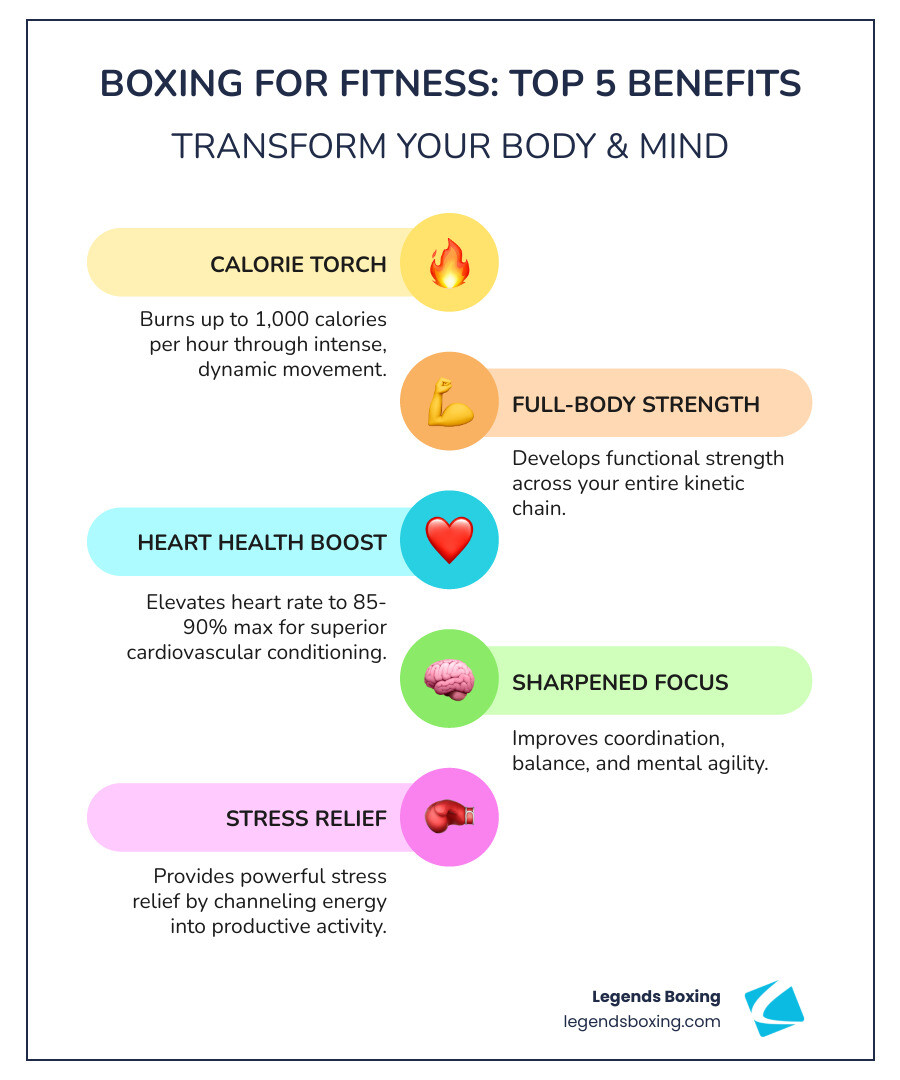
Boxing training for fitness is a high-intensity workout combining punches, footwork, and conditioning to build strength, burn calories, and relieve stress—no fighting required. Here's what makes it so effective:
- Burns up to 1,000 calories per hour with intense, full-body movement.
- Raises heart rate to 85-90% of maximum for superior cardiovascular conditioning.
- Engages your entire kinetic chain—legs, core, and upper body—for functional strength.
- Improves coordination, balance, and mental focus through precise movements.
- Provides powerful stress relief by channeling energy into physical activity.
If you're tired of boring gym routines, boxing might be your answer. It keeps you mentally engaged while delivering results you can see and feel. You're not just moving; you're learning a skill, building power, and changing your body.
I'm Robby Welch, National Head Coach for Legends Boxing. With over two years of experience, I've helped hundreds build physical strength and unshakeable confidence through boxing training for fitness. In this guide, I'll show you how to get started, what to expect, and how to structure your training for maximum results.
Boxing training for fitness vocab explained:
Why Boxing? The Unbeatable Full-Body Benefits
Boxing training for fitness delivers total body conditioning that most workouts can't match. It engages your legs, core, arms, and mind simultaneously, forcing you to think, move, and adapt. You can build the same strength, speed, and endurance as elite boxers without ever stepping into a competitive ring.
A solid boxing workout can torch up to 1,000 calories an hour. The high intensity also means you'll continue burning more calories during and after exercise, making it a powerful tool for fat loss and building lean muscle.
Beyond the physical, boxing is an incredible outlet for stress relief. Research has shown that non-contact boxing can reduce symptoms of anxiety and depression. The required focus creates a form of moving meditation, clearing your mind while strengthening your body.
Dynamic footwork and punch combinations also dramatically improve coordination and balance. Better body awareness prevents injuries and improves performance in other activities. One study even found that boxing improved balance and cognitive abilities in stroke patients, showing its powerful benefits for everyone.
The Cardiovascular Knockout
Boxing training for fitness pushes your heart rate to 85-90% of its maximum, strengthening your heart and lungs while building incredible stamina. Unlike steady-state cardio, boxing naturally challenges both aerobic and anaerobic systems. The aerobic system powers sustained movement, while the anaerobic system fuels explosive combinations.
This mix makes boxing a perfect High-Intensity Interval Training (HIIT) workout. You alternate between intense bursts and brief recovery, keeping your heart rate liftd and preventing boredom. The result is a stronger heart, more efficient lungs, and stamina that makes everyday activities feel effortless.
Building Functional Strength and a Powerful Core
Boxing builds functional, real-world strength by training your body to work as one connected unit—the kinetic chain. A powerful punch doesn't start in your arm; it starts from your feet, travels through your legs, rotates through your hips and core, and explodes through your fist.
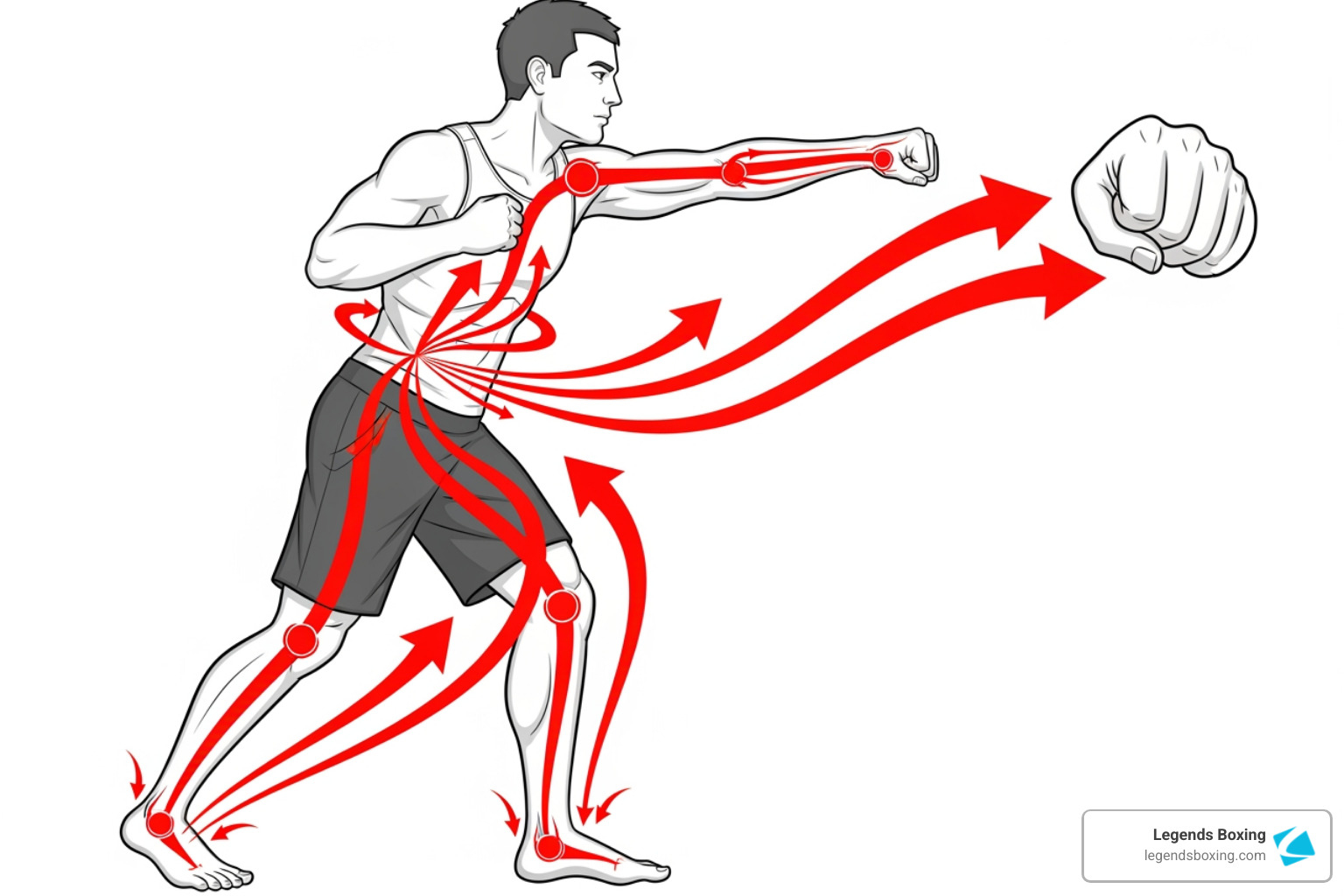
Your core is the vital link, transferring energy and creating the "snap" behind each strike. This means boxing training for fitness builds a rock-solid core through constant rotation and stabilization. You'll develop powerful legs from footwork, a strong core from twisting, and defined shoulders, back, and arms from punching. More importantly, you'll improve how your body moves as a coordinated unit, building strength that's useful in everyday life.
Gearing Up & Mastering the Basics
You don't need to break the bank to start boxing training for fitness, but the right gear and proper technique are key for safety and effectiveness. We always emphasize technique over power, especially for beginners, to ensure your workouts are both effective and injury-free.

Essential Equipment for Your Boxing Journey
Here are the essentials for training safely and effectively:
- Boxing gloves: Your first priority for protecting your hands and wrists.
- Hand wraps: These are not optional. They support the small bones in your hands and prevent injury.
- Jump rope: A boxer's best friend for warm-ups, footwork, and cardio.
- Heavy bag: A great investment for home training to build power and stamina (we have plenty at our gyms).
- Focus mitts: Used for partner drills to sharpen timing, accuracy, and speed.
- Comfortable athletic wear: Allows you to move freely. Athletic shoes are fine for starting out, though boxing shoes offer better support for advanced training.
Fundamental Boxing Techniques for Beginners
Mastering the basics is what makes boxing training for fitness so effective. Proper technique is everything.
- Boxing Stance: Your foundation for balance, mobility, and power. Feet are shoulder-width apart, knees bent, with hands up to protect your face.
- Footwork: Agile footwork allows you to control distance, create angles, and stay balanced. We'll teach you to be light on your feet.
- The Six Basic Punches: The jab is a quick lead-hand punch to set up combinations. The cross is your rear-hand power punch. The hook is a curving punch powered by your hips, and the uppercut is an upward punch driven by your legs and hips.
- Defensive Moves: Defense is just as critical. The slip is a head movement to evade straight punches, while the roll is a ducking motion to let punches go over your shoulder.
Focus on mechanics before power. Speed and strength will follow as your technique improves. Our coaches are here to refine your form every step of the way. To see how it all comes together, check out what to expect in a class.
The Ultimate Boxing Training for Fitness Workout
Every great boxing training for fitness program needs structure and progression. At Legends Boxing, our workouts are designed to challenge you at your current fitness level while building your strength and skill over time. This concept of progressive overload ensures you're constantly improving.
Our classes blend shadow boxing, partner drills, heavy bag work, and conditioning into a cohesive experience that keeps you engaged. If you're curious about the atmosphere, check out what to expect in a class. It's fun, intense, and you'll leave feeling like a champion.
Anatomy of a Boxing Workout Session
Behind the high energy of a Legends class is a carefully structured workout designed for maximum results and safety. A typical session includes:
- Dynamic Warm-up (5-10 mins): We use jump rope, arm circles, leg swings, and light shadow boxing to lift your heart rate, improve mobility, and prevent injuries.
- Skill Work: Here, technique is king. You'll work on punch combinations and footwork, often with a coach or partner using focus mitts to sharpen your accuracy and timing.
- Conditioning: This is where the magic happens. You'll do multiple rounds on the heavy bag to build stamina and power, integrated with bodyweight circuits (squats, push-ups, planks, burpees) to build muscular endurance.
- Cool-down: We finish with static stretching and foam rolling to improve flexibility, aid muscle recovery, and reduce soreness. This phase is crucial for letting your body repair and get stronger.
The Role of Strength and Conditioning
While boxing is the core, we integrate serious strength and conditioning to build raw power and resilience. We focus on compound exercises that engage multiple muscle groups, just like boxing itself.
- Key Exercises: Squats and deadlifts build lower body and full-body strength for power generation. Push-ups and pull-ups strengthen your upper body for punching and retracting strikes.
- Explosive Power: Plyometrics like jump squats develop the speed and explosive power that translate directly to faster, more powerful punches.
Performed 2-3 times per week, these exercises build a strong foundation. We adapt principles from resources like the USA Boxing International Open Strength & Conditioning Plan for your fitness journey, using tools like resistance bands to build power safely.
Boxing Cardio vs. Traditional Cardio
If you're tired of the treadmill, you'll appreciate how boxing training for fitness offers a superior cardio experience.
| Feature | Boxing Cardio | Traditional Cardio (e.g., Treadmill Running) |
|---|---|---|
| Engagement Level | High mental and physical engagement; constantly learning and reacting; prevents boredom. | Can be monotonous; often requires external distractions (music, TV) to maintain interest. |
| Muscle Groups Worked | Full-body workout; engages legs, core, back, shoulders, and arms simultaneously; builds functional strength. | Primarily lower body; limited upper body and core engagement unless specific variations are added. |
| Calorie Burn | Very high intensity, leading to significant calorie burn during and after exercise (up to 1,000 calories/hour). | Moderate to high, depending on intensity; generally lower post-exercise calorie burn compared to HIIT-style boxing. |
| Skill Development | Develops coordination, balance, agility, timing, and mental focus; teaches self-defense fundamentals. | Primarily improves endurance; minimal skill development beyond maintaining pace and form. |
| Mental Focus | Requires intense concentration on technique, combinations, and movement; provides stress relief and mental clarity. | Can be meditative but often allows mind to wander; less direct impact on cognitive skills like reaction time and strategic thinking. |
Boxing keeps your mind fully engaged as you learn combinations, react to cues, and coordinate complex movements. This mental challenge prevents boredom while your heart rate stays in the optimal 85-90% range. It's dynamic, challenging, and delivers results without the monotony of traditional cardio.
Level Up: Scheduling, Nutrition, and Common Mistakes
The magic of boxing training for fitness happens both inside and outside the gym. To see lasting results, you need a smart approach to training, nutrition, and recovery.
Ready to find a Legends Boxing gym near you? We have locations in Bountiful UT, Cache Valley UT, Jordan Landing UT, Lee Vista FL, Lehi UT, Meyerland TX, Orem UT, Riverton UT, Sandy UT, Saratoga Springs UT, and St. George UT.
Structuring your weekly boxing training for fitness schedule
A sustainable routine is key to success. Aim for a balanced week to challenge yourself without burning out:
- 2-3 boxing sessions: These are your foundation for cardio, technique, and conditioning.
- 1-2 strength training days: Focus on compound movements (squats, deadlifts) to build explosive power.
- 1 active recovery day: A gentle walk, yoga, or mobility work keeps blood flowing to your muscles.
- 1-2 complete rest days: Rest is when your muscles grow and your body gets stronger. Don't skip it.
Consistency always beats sporadic, high-intensity efforts. Balance your workouts with adequate recovery.
Eating Like a Fighter: Nutrition for Fitness
You cannot out-train a bad diet. Boxing training for fitness demands premium fuel for energy, performance, and recovery.
- Fuel: Eat complex carbohydrates (sweet potatoes, oats) for sustained energy 1-1.5 hours before training.
- Repair: Consume lean proteins (chicken, fish, eggs) to repair and build muscle.
- Support: Include healthy fats (avocados, nuts) for long-lasting energy and cellular health.
- Hydrate: Water is critical. Drink plenty throughout the day and especially before class.
- Recover: Within an hour after training, have a meal or shake with protein and carbs to kickstart muscle repair. This go-to protein shake recipe is a quick and effective option.
Common Beginner Mistakes and How to Avoid Them
Enthusiasm is great, but avoid these common pitfalls to stay safe and progress faster:
- Ignoring the warm-up: Your muscles need 5-10 minutes to prepare for intense work. Never skip it.
- Punching with only arm strength: Real power comes from the ground up, rotating through your legs, hips, and core. We'll teach you the proper kinetic chain.
- Holding your breath: Exhale sharply with each punch to maintain power and avoid gassing out.
- Sacrificing form for power: Focus on correct mechanics first. Power will come naturally with good technique.
- Overtraining: More isn't always better. Your body needs rest to adapt and get stronger. Listen to your body and take rest days when needed.
Frequently Asked Questions about Boxing Fitness
Do I need any boxing experience to start?
Absolutely not. You need zero boxing experience to start boxing training for fitness at Legends Boxing. Our classes are designed for beginners, and our coaches love teaching the fundamentals from the ground up.
We'll teach you everything from how to wrap your hands to how to throw your first jab. The focus is entirely on fitness, technique, and having fun—not fighting. Everyone in class started exactly where you are. Ready to try? Find a gym near you and see for yourself.
How often should I do boxing training for fitness?
The ideal frequency for most people is 2-4 sessions per week. This allows for consistent progress while giving your body the recovery time it needs to get stronger. Muscles grow during rest, not during the workout.
Consistency is more important than frequency. Sticking to 3 sessions a week long-term is better than burning out after a few weeks of going every day. Listen to your body—if you're overly sore or tired, take an extra rest day.
Is boxing a good way to lose weight?
Yes, boxing training for fitness is one of the most effective workouts for weight loss. You can burn up to 1,000 calories per hour. Beyond the immediate calorie burn, boxing builds lean muscle, which boosts your metabolism and helps you burn more calories at rest.
Research confirms that high-intensity boxing is effective in reducing body fat percentage. Plus, people stick with it because it's fun and engaging. For best results, combine your workouts with a healthy diet. This powerful combination is a proven formula for changing your body.
Conclusion
You now see why boxing training for fitness is a true game-changer. It's a complete approach to physical and mental wellness that delivers lasting results. You'll build functional strength, develop powerful cardio, sharpen your focus, and find an incredible outlet for stress.
Beyond burning up to 1,000 calories per hour and building lean muscle, you'll find a strength you didn't know you had. You'll push past limits and become part of a community that celebrates every victory. At Legends Boxing, we've seen countless people transform into confident, powerful versions of themselves. Our community is built on support and the shared goal of becoming better.
Whether you're a complete beginner or looking to shake up your routine, you have a home here. The path to your strongest self starts with one decision. You don't need to be in shape or have any experience—you just need to show up. Our coaches will guide you, our community will cheer you on, and you'll be amazed at what you can achieve.
Ready to release your inner fighter and see what boxing training for fitness can do for you? Book a free workout at your nearest Legends Boxing location today. Your change is waiting.


